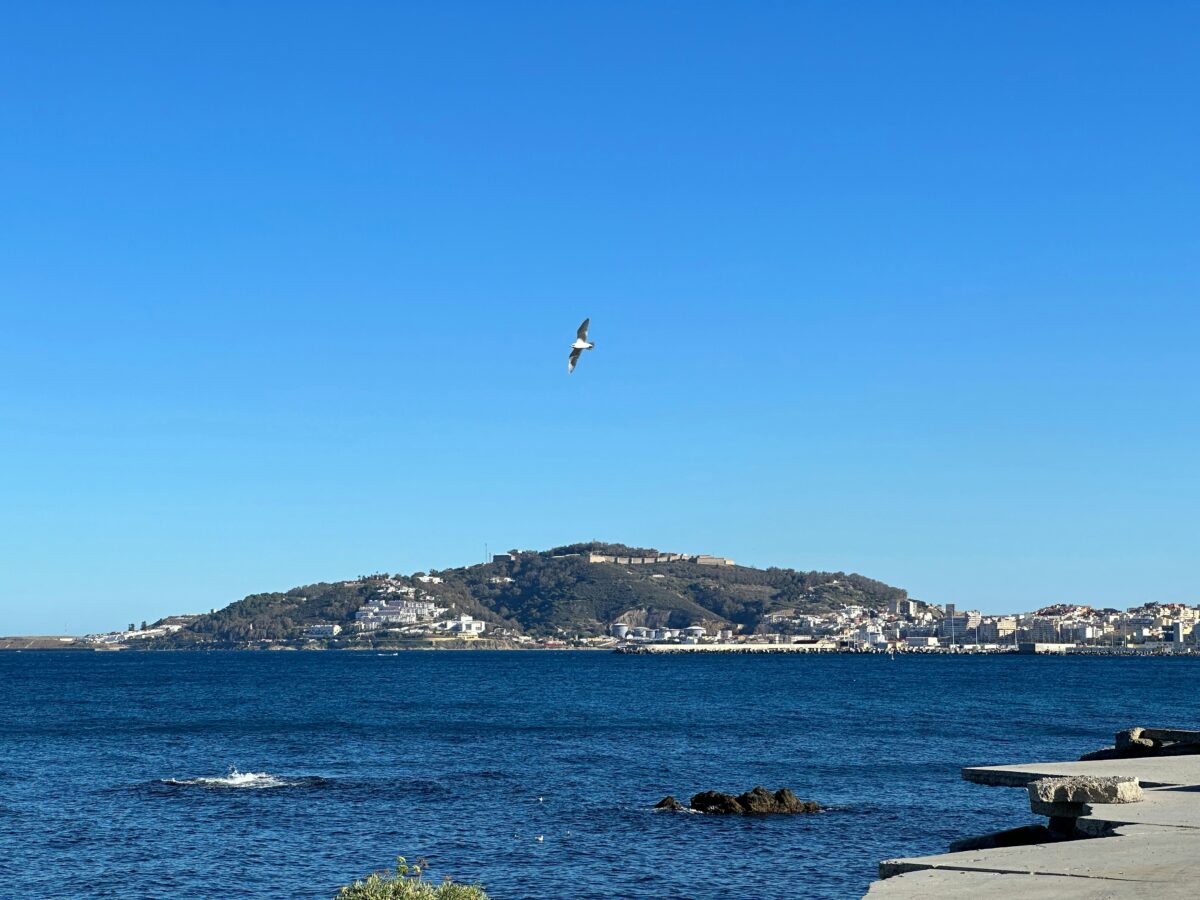
- Introduction: The events of 31 July 2026 and preliminary remarks
- Decolonisation of Ceuta and the objection of the “timing”
- Decolonisation of Ceuta and the objection of the “Hispanicity” of its inhabitants
- The position of Morocco and of the African Institutions
- The doctrine of the “colonial enclaves”
- Final reflections
Introduction: The events of 31 July 2026 and preliminary remarks
On Thursday, 30 July 2026, roughly 50,000 to 60,000 migrants crossed from Morocco into the Spanish exclave of Ceuta. The surge involved people swimming, using inflatables, or rushing border gates, triggered by social media rumours, and resulted in at least 67 deaths. More specifically, on 29 June, the Spanish Supreme Court ruled that, because people swimming to Ceuta do not cross the physical border fence, they must be processed under more stringent legal procedures before they can be deported back to Morocco. The Spanish Supreme Court’s judgment provided a clarification that the “rejection at the border” regime does not apply to migrants intercepted while attempting to reach Ceuta by sea. Within days, the ruling was altered online into an “open invitation”. New accounts and pages claimed Spain had “opened the way” for anyone arriving by sea and that returns were no longer possible. Smuggling networks across Morocco and Algeria joined the campaign. A Facebook/Instagram page called “Hagra Sueta 26” (“Injustice/Humiliation of Ceuta 26” (combining Moroccan Arabic slang and a geographic location) displayed photographs and videos of successful swimmers.
This event sparked numerous debates about the “migration crisis” in Europe and Italy’s consequent suspension of the Schengen Treaty. On the other hand, this recent event has also revived the debate over why Ceuta, geographically on the African continent, is still ruled by the Spanish Government as an “autonomous city” since 1995, instead of being an independent territory or being under the rule of Morocco. Among other aspects, this autonomy implies that, according to Article 5(h) of Law 1/1995 on the autonomy of the city, the local administration must safeguard the cultural, but not, for example, the linguistic and religious plurality of the city. For in Ceuta Castilian is the official language, but the inhabitants of Moroccan origin and Muslim faith, who numerically represent the second most important community of the city, have as their mother tongue Darija (or dialectal Arabic) in Ceuta. Unlike other Spanish bilingual regions, there has never been in Ceuta either defence or promotion of this language spoken by the Muslim collective. In converse, and although not explicitly mentioned in Law 1/1995, religious pluralism is governed in Spain by Section 16 of the Constitution and by the national Religious Liberty Law of Spain, General Act 7 of 5 July 1980.
Under these circumstances, I would like to make clear that my understanding of “decolonising” Ceuta does not automatically imply that the city is an integral part of the present Kingdom of Morocco (Morocco). For example, it could also become a city with a local self-government, like the Republic of San Marino, which presently has less than half the population of Ceuta. Ceuta, in 2025, counted almost 84,000 inhabitants, while San Marino, a sovereign country with a seat at the United Nations (UN) since 2 March 1992, has around 34,000. Yet, as the major efforts in these last decades have been made by the Kingdom of Morocco in order to incorporate it, this piece will assume this last option as the most likely in case of “decolonisation” of Ceuta.
In this short piece, I would like to clarify several aspects about why, in my opinion, discussing a “decolonisation” of Ceuta should not be a taboo subject. Far from being completely exhaustive, this piece simply offers reflections on this geographical “exception” in a continent that has been decolonised almost in full.
Although administratively under the Government of Spain, Ceuta is not part of the “Schengen Area”. The “Schengen Area” covers over 4 million square kilometres with a population of over 450 million people, allowing free travel between member countries without going through border controls. Presently, the Schengen Area includes 29 European countries.
Unlike Spaniards on the mainland, people living in Ceuta cannot travel freely to the rest of Europe. This happened even before the late July 2026 migration crisis, and this situation reminds me of some of the “special regimes” that have been historically applied to many colonies in Africa, for which the freedom of movement of their residents has been restricted until the end of colonisation. When Spain acceded to the Schengen Convention in 1991, Ceuta was excluded from the Schengen provisions that eliminate border checks between the member countries of the Schengen Area. A declaration attached to the agreement on Spain’s accession to the convention stated that Spain would maintain checks on sea and air connections from Ceuta to other Spanish-territory destinations and to other parts of the Schengen Area.
Decolonisation of Ceuta and the objection of the “timing”
The Portuguese conquest of Ceuta took place when forces under the command of King John I conquered the North African city from the Marinid Sultanate on 21 August 1415. The capture of the city marked the beginning of the Portuguese Empire. Ceuta remained under Portuguese control until it was transferred to Spain in 1668. The Portuguese conquest is generally considered a founding moment in the Portuguese overseas expansion. The looting of the city has been described as “immense”. Yet commentators have historically and legally defined the Portuguese presence in Ceuta as an “occupation”.
One of the major objections to Ceuta being incorporated into Morocco is that, quoting a Spanish scholar, “the conventional origin of the Moroccan state is generally placed in the late eighth century, with the Idrisid dynasty. Modern Morocco recovered the full exercise of its independence in 1956, but it did not come into existence as a political entity at that time”. By this logic, Ceuta can not be understood as a consequence of the Spanish Protectorate in Morocco, established on 27 November 1912. This happens because, by the time the Protectorate began, quoting the scholar above, “the city had already spent almost five centuries under the sovereignty of Christian Iberian crowns and more than two centuries recognised by Portugal as part of the Spanish Monarchy”. In sum, the Spanish origins of Ceuta predate the existence of the contemporary Kingdom of Morocco.
In my opinion, this is not a conclusive objection given that the “timing” of the occupation of a territory has never been decisive for the decolonisation of Africa. In this regard, many current sovereign African states did not even exist before the formal colonisation ended in the second half of the 20th century, but this has not prevented them from becoming present sovereign countries of Africa.
For example, according to the above logic, Chad, whose present territory corresponds to the territory of the colonised “French Chad”, should not be currently an independent country with its present borders because, de facto, it never existed before those French occupiers reunited different territories belonging to local kings. If, according to the above logic, a city occupied for six centuries by Europeans cannot be decolonised, why would it be decolonised a country that, in its current form, did not even exist before colonisers arrived in Africa?
On a different note, the Portuguese first occupied the islands known today as the Republic of Cabo Verde in 1462, when they founded Ribeira Grande (now Cidade Velha) on Santiago Island. Unlike Ceuta, it has been widely acknowledged that Cabo Verde was uninhabited, with no native or indigenous population before Portuguese and Genoese explorers arrived in the XV Century. The Portuguese ruled over that archipelago for more than 500 years, with Cap-Verdeans, who were officially granted full Portuguese citizenship in 1961. Despite this very long history dominated by Portuguese administration on those islands, Cabo Verde achieved full independence on 5 July 1975. In this regard, it is well-recognised that “colonialism” in Africa had different stages, to quote an author, “From Occupation of Land to Occupation of Being”. The protracted presence of a European occupier has, nevertheless, never been an insurmountable obstacle, so far, to decolonise the territories of the continent.
Decolonisation of Ceuta and the objection of the “Hispanicity” of its inhabitants
Another objection to the decolonisation of Ceuta has been the will of Ceuta’s population to remain “Spanish”. On one hand, I fully understand that a city presently ethnically and culturally formed by a majority of people having strong ties with Spain would prefer to remain “Spanish” (yet, I am wondering what would happen if the ethnic and demographic composition of the city were different, with a stronger presence of Muslim North Africans). On the other hand, however, I can add that there have been and are cases, also (but not exclusively) in Africa, in which the will of the local population has not always been taken into consideration vis-à-vis its self-determination, as shown by the following examples.
On 31 May 2001, residents of Somaliland, which claims to have been the first East African country to have obtained independence (on 26 June 1960), went to the polls for a referendum on a Draft Constitution that affirmed Somaliland’s independence from Somalia. 99.9% of eligible voters took part in the referendum, and 97.1% of them voted in favour of the constitution. The ratification of the Constitution confirmed Somaliland’s independence. Still today, however, and in spite of its recent recognition by Israel (and, informally, by several others) Somaliland is not a recognised state worldwide.
In another context, in early 2026, the Front for the Liberation of the Enclave of Cabinda (FLEC) has proclaimed the unilateral independence of the region, an oil-rich Angolan exclave, citing self-determination rights and the 1885 Treaty of Simulambuco. This declaration, however, lacked international recognition, while the Angolan Government maintains absolute territorial integrity over the region, although FLEC has recently appealed to US President Donald Trump to act as a mediator in resolving the Cabinda affair. This was not the first time FLEC tried to declare Cabinda’s independence. On 1 August 1975, the FLEC first proclaimed the “Republic of Cabinda”, attempting to create a fait accompli that would precede Angolan independence from Portugal, scheduled for 11 November. FLEC, however, was operating mainly from exile, and its actual control over Cabindan territory was limited.
On 26 October 1997, an independence referendum was held on Anjouan, an island in the Comoros archipelago. While over 99% of voters voted in favour of independence, no national or international authority recognised the vote, and the island returned to the control of the Comorian Government in 2002.
On 27 October 2013, the Ngok Dinka community in the disputed Abyei region of Sudan held a unilateral vote to determine whether Abyei would remain part of Sudan or join South Sudan. The AU strongly condemned the referendum as “unacceptable and irresponsible”. Abyei is currently contested between Sudan and South Sudan. The land has been invaded twice by the Sudanese army since the signing of the 2005 Comprehensive Peace Agreement (CPA) between the Sudan Government and the Sudan People’s Liberation Movement and its Army, SPLM/A. After the last invasion in 2011, Sudan was persuaded to withdraw its troops and the United Nations Interim Security Force for Abyei (UNISFA) was established on 27 June to provide interim protection for the population, which it now does, albeit with limitations in the mandate and territorial coverage. The CPA grants the people of Abyei dual citizenship pending the resolution of the final status.
Additionally, while several African countries have become independent through a referendum, such as Guinea (1958) and Djibouti (1977), in many others their destiny has not been decided by consulting the local population. Rather than being consulted on the formation or independence of these states, local populations inherited rigid geographic units that ignored pre-colonial ethnic, linguistic, and kingdom boundaries. For example, the Democratic Republic of Congo, former Zaire, is the result of assembled territories (by Belgium) out of a vast, resource-rich region containing over 200 ethnic groups with no prior shared national identity. The country rushed into independence in 1960 under terms heavily influenced by Belgian administrative structures. Similarly, Nigeria is a country that combined distinct major groups – the Hausa-Fulani in the north, Yoruba in the southwest, and Igbo in the southeast – along with hundreds of smaller communities into a single British colonial territory that transitioned directly into independence without a foundational referendum on its borders.
The examples provided above, while not necessarily demonstrating that the wishes of Ceuta’s population may be disregarded, on the other hand, clearly demonstrate that in many instances the wishes of local populations have not been taken into consideration in shaping the Africa as we see it today.
The position of Morocco and of the African Institutions
In converse, the December 1958 All-African Peoples’ Conference held in Accra officially advocated grouping newly freed territories based on “geographical continuity” (Ceuta is geographically in Africa) and “shared cultural traits”. In this regard, Ceuta, before the conquest by the Portuguese, was a Muslim city like the rest of Northern Africa, defended by a composite system of walls built by various Islamic dynasties over the centuries. The first, highly symbolic act of the Portuguese once the city was conquered was to consecrate the main mosque as the city’s cathedral.
Moreover, from its inception, the Organisation of African Unity (OAU) recognised the strategic and moral importance of fully decolonising the African continent. Its 1963 Charter committed unequivocally to “eradicating all forms of colonialism from Africa” (Article 2(d)). In this regard, I am wondering if the long-standing presence of two former European colonial powers in a city lying on the shores of Africa does not amount to a remnant of colonialism. This is an idea that I share with eminent scholars as well.
In its 2014 study, Delimitation and Demarcation of Boundaries in Africa: General Issues and Case Studies, the African Union Border Programme (AUBP), established in 2007 as part of the African Union’s efforts to strengthen structural conflict prevention capacities, has been clear in setting several principles at the foundation of its work. Among them, “[t]he principle of respect for the boundaries that existed on achievement of national independence does not preclude the adjustment of boundary alignment to meet local requirements” (p. 24). Additionally, “uniformity by reference to uti possidetis is no universal panacea to conflict, but instead a dangerous substitute for contextualisation” (p. 42), meaning that the principle of uti possidetis, by which newly independent states inherit the exact colonial administrative borders that existed at the moment of their independence, should be assessed case by case.
The joint declaration of Morocco and Spain dated 7 April 1956, which acknowledged the end of the Spanish Protectorate established by the Treaty of Fez of 1912, recognised Morocco’s independence and its “territorial integrity” (para 2). A few days before signing the declaration, Morocco’s King Mohammed V proclaimed “nous n’avons jamais dissocié indépendance et unité” [“We have never separated independence from the unity of the territory”].
The discourse of “integrity”, characterised by a refusal to accept the division of the country into zones and enclaves, was central to Morocco’s claims over Ceuta, regarded as Moroccan soil. This discourse was a broader feature of early decolonisation. Just before Moroccan independence, similar arguments had already been advanced by Indonesia to justify its annexation of West Irian, and a few years later they would be deployed as a ground for India’s takeover of Goa and the other Portuguese dependencies on its Arabian shoreline (paras. 46-47). Since 1956, Morocco has maintained that Ceuta is a usurped city under Spanish occupation and considers it one of the last colonies in Africa. Morocco first protested about Ceuta in the UN on 7 October 1960 when Mr Sidi Babam, representative of Morocco, said that despite Morocco’s undoubted historic rights to Ceuta, the city had been forcibly detached from its country. “The inhabitants were unquestionably Moroccan and had always claimed to be so, despite blind colonialist oppression” (para 46).
On 27 January 1975, Morocco asked the UN Decolonisation Committee (UNDC) to include the “colonial enclave” (para 3) of Ceuta on the list of non-self-governing territories, declaring that it was “among the last vestiges of colonial occupation” (para 1) and calling for the restoration of Morocco’s “territorial integrity” (para 2). Finally, Ceuta was never part of that list, despite Morocco’s request. In this regard, while several authors argue that Ceuta should not be considered a city to decolonise because it was never included in that list, I do not endorse this view. In Africa, countries like Eritrea (independent since 24 May 1993) and South Sudan (independent since 9 July 2011) were never part of that list (which has existed since 1946) either, but this did not prevent them from becoming independent with full worldwide recognition.
In July 2002, a squad of Moroccan marines launched an “invasion” of Perejil, a Spanish desert island off the coast of Ceuta. This sparked a weeklong crisis that concluded when the Spanish Army Special Operations Groups (known in Spanish as Grupos de Operaciones Especiales /GOE) were deployed to evict them, although the Moroccan Government urged the immediate and unconditional withdrawal of Spanish forces, affirming that Perejil was “an integral part of Moroccan territory”. Additionally, in a similar incident to that of late July 2026, a massive influx of migrants on 17-18 May 2021, some 8,000 people surged into Ceuta. The Spanish Government responded by moving security forces to the area and implementing a pushback mechanism. Most of the new arrivals were returned to Morocco within a few days of the incident. In the aftermath of the incident, the conservative Istiqlal Party highlighted that the territorial integrity of the Kingdom of Morocco was incomplete without recovering all occupied Moroccan lands, including Ceuta. In a statement on 20 May 2021, the Moroccan Foreign Minister, Nasser Bourita, confirmed that the discomfort in Rabat had its origin in Spain’s secretive admission of Polisario Front leader Brahim Ghali for medical treatment (Bourita asserted that Madrid coordinated with Morocco’s adversaries using a false identity); thus, the issue of the return of Ceuta to Morocco was not ancillary. The Polisario Front is a politico-military organisation striving to end Moroccan control of the former Spanish territory of Western Sahara and win independence for that region. The Polisario Front first began in May 1973 as an uprising against Spanish control of Western Sahara.
With reference to the African institutions, in its resolution of 21 February 1975, the Council of Ministers of the OAU expressed its solidarity with Morocco’s attempts to recover Ceuta, which it too referred to as a “colonial enclave on the northern coast” (para 1). The OAU showed this solidarity both because it reaffirmed “the firm determination of the Member States to complete the total liberation of the African continent as soon as possible” and because it considered “that the maintenance by Spain of the colonial enclaves on Moroccan territory constitutes a threat to the African countries” (Preamble). Through the same resolution, the OAU also launched “an urgent call to Spain to accelerate the process of the decolonisation of the enclaves and to start negotiations on the subject with Morocco” (para 3).
The doctrine of the “colonial enclaves”
Morocco’s and the OAU’s reliance on the concept of a “colonial enclave” reflects doctrinal developments in 1970s international law scholarship. This doctrine was later developed and made popular by James Crawford. Crawford defines “colonial enclaves” as “minute territories which approximate to “enclaves” of the Claimant State, which are ethnically and economically […] derivative of that State, and which cannot constitute separate territorial units” (p. 647). A territory that falls into this recognised category is said by Crawford to have “no legitimate separate identity” (p. 637). In this regard, I can mention, for example, that before the arrival of the Portuguese and later the Spanish, Ceuta was a rich and fortified trading hub under Islamic rule for more than seven centuries. Additionally, like most of North Africa, the city was mostly inhabited by people of Arabic descent. This resulted in the timely relevance of Islam and Arabic communities, even though European and Christian communities were present for centuries.
In more detail, the doctrine of the “colonial enclaves” offers a basis for the legal arguments raised by Morocco in its claim of Ceuta. This doctrine is strictly associated with a particular interpretation of paragraph 6 of the UNGA Resolution 1514 (XV) (14 December 1960) prohibiting “[a]ny attempt at the partial or total disruption of the national unity and the territorial integrity of a country”. Resolution 1514 is the historic “Declaration on the Granting of Independence to Colonial Countries and Peoples” that proclaimed the absolute necessity of ending colonialism unconditionally. Morocco interpreted paragraph 6 in the way that it can apply to an existing situation, and not only to future action, as the word “attempt” would suggest. In this regard, a reference to paragraph 6 of Resolution 1514 in the preamble to the UNGA Resolution 2353 (XXII) on Gibraltar (19 December 1967) may have powered the enthusiasm of Morocco for the interpretation of paragraph 6, an interpretation that reflects the limits of a contemporary international legal environment, which leaves very little opportunity for territorial revisionism.
For the purpose of my work, it is essential to note that Spain has embraced the “irredentist interpretation” of Paragraph 6 in the context of its claim to Gibraltar. The Preamble of Resolution 2353 clearly interpreted Paragraph 6 of Resolution 1514 to the advantage of Spain vis-à-vis the situation of Gibraltar, affirming that Paragraph 6 was contrary to “any colonial situation which partially or completely destroys the national unity and territorial integrity of a country” (in this case, Spain). In Paragraph 3 of Resolution 2353 on Gibraltar, the UNGA invited “The Governments of Spain and the United Kingdom of Great Britain […] to resume without delay the negotiations […] with a view to putting an end to the colonial situation in Gibraltar and to safeguarding the interests of the population upon the termination of the situation”. In such a scenario, Morocco has clearly sought to exploit this common normative understanding by insisting on the parallel between Gibraltar and Ceuta. In summary: As Spain was claiming back Gibraltar, Morocco, under a similar interpretation of the same provisions contained in the two resolutions, was claiming back Ceuta.
Final reflections
Although Spain, through its Defence Minister Margarita Robles, has been resolute in its refusal to negotiate over Ceuta even very recently, its case, ultimately, in my opinion, is not very different from the case of other African regions that have already been decolonised. If it is not surprising that the Moroccan press is aligned in advocating for the return of Ceuta to Rabat (proposing the creation of a Moroccan-Spanish Commission that should set the different stages of the decolonisation and supervise the return), questions over Spain’s centuries-old control of the city have also been raised by other countries. In a 30 April 2026 US Congress Report, submitted by US Congressman Mario Díaz-Balart, who serves on the Committee on Appropriations, we can read, “[T]he Committee notes that the Spanish-administered cities of Ceuta and Melilla are located in Moroccan territory and remain the subject of Morocco’s longstanding claim. The Committee supports efforts by the Secretary of State to encourage diplomatic engagement between Morocco and Spain on the future status of Ceuta and Melilla”. Responding to a question posed during an interview, Diaz-Balart also stated, “Ceuta and Melilla are in Moroccan territory” and questioned whether the autonomous cities “are part of Spain or should be part of Morocco”.
On 1 August 2026, Danny Danon, Israel’s Ambassador to the UN, declared, “Maybe before [Spain] continues lecturing us, it is time it explains to the world why it still maintains colonial enclaves in Africa”.
However, thinking that the doubts about the “Hispanicity” of Ceuta are recent, it may be wrong. As early as the late 1970s, former Spanish King Juan Carlos seemed to be unsure that he could hold Ceuta indefinitely. In the 2026 book “The First Ambassador of Democracy: King Juan Carlos and Spain’s International Projection”, historian Charles Powell cited a confidential US Embassy telegram documenting a conversation that took place on 30 April 1979, between the King and Edmund Muskie, President Jimmy Carter’s special envoy. During the conversation, King Juan Carlos realised that, differently from what he had thought about Melilla, Spain could not simply hand Ceuta over to Morocco because of the presence of a large number of Spaniards living there. Instead, the King considered placing Ceuta under an international arrangement resembling the status Tangier had before Moroccan independence. On 18 December 1923. the United Kingdom, France and Spain stipulated a Convention Regarding the Organisation of the Tangier Zone (“Tangier Zone Statute”). It took effect on 1 July 1925. The first principle of the Tangier Zone Statute placed the Tangier Zone under a regime of permanent neutrality. The second principle determined that no military establishment should be either created or maintained in the Tangier Zone (both mentioned in Article 3 of the Tangier Zone Statute).
According to the Moroccan journalist Tarik Qattab, who wrote on 30 July 2026, the position of Rabat on Ceuta is clear: “La restitución de Sebta […] se perfila como una salida ineludible a largo plazo, impulsada por la confluencia de la geografía, la demografía y el sentido común. La cuestión central ya no es determinar si estas ciudades [Melilla included] se reintegrarán en su entorno natural, Marruecos, sino en cuánto tiempo ocurrirá y cuántos dramas humanos deberán lamentarse hasta entonces”. [The central question is no longer whether these cities (Ceuta and Melilla) will be reintegrated into their natural environment, Morocco, but how long it will take and how many human tragedies will have to be endured in the meantime].
In light of the above analysis, and far from considering my opinion as fully exhaustive, I hope to have shown that while the decolonisation of Ceuta should not be declared forcibly tomorrow, on the other hand, its decolonisation is not even a “taboo topic” to be excluded a priori. Perhaps to solve the dispute over Ceuta, we should listen to the former Moroccan King, Hassan II, who in 1982 stated that “time, friendship and flexibility” could be the key to solving this territorial dispute with Spain. This was in order to avoid a repeat of the “Green March” (which Spain fears), the demonstration organised by the Moroccan Government on 6 November 1975, with 350,000 unarmed Moroccan volunteers who crossed the border into the Spanish Sahara to force Spain to hand over control of that territory.
Editor’s Note: This article is substantially longer than our regular blog posts. However, due to the quality and relevance of this thought-provoking article, we found it fitting to publish an article of this length.

One reply on “Why the decolonisation of Ceuta should not be a “taboo topic””
If we want to “fully decolonise Africa”, we need to also consider the Arabian colonies: Morocco, Algeria, Tunisia, …