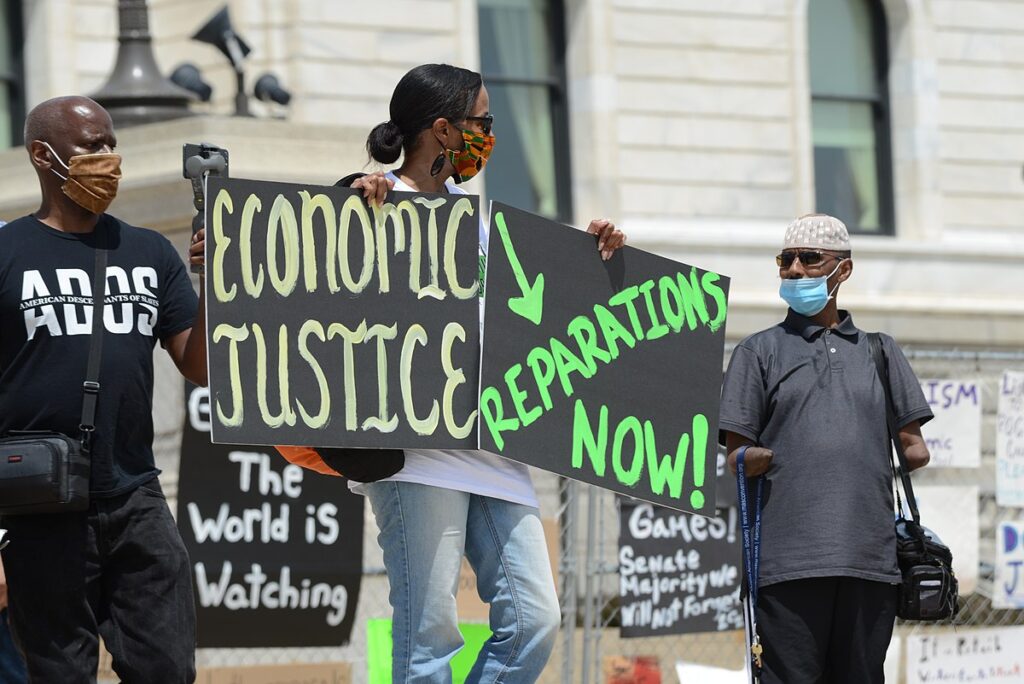
The Dawn of a New Era for Reparatory Justice?
On 25 March 2026, the UN General Assembly adopted a historic Declaration, designating the transatlantic slave trade as “the gravest crime against humanity.”[1] The Declaration was adopted with a “yes” vote from 123 Member States, a “no” vote from Argentina, Israel, and the USA, and an abstention from 52 countries. Included in the latter category are virtually all so-called Global North countries (and others), including those that have a very controversial history either as former colonisers or as major beneficiaries of the transatlantic slave trade. The “collective” abstention of Global North countries, no less obstructive than the three contrarian votes, is indicative of the difficulty of the struggle to make the world a better place for all, doing this by ushering concrete foundations for an equitable global political order.
Lessons to Public International Law and African Union Law
It is important to note that while this issue is fundamentally related to broader questions of global inequalities, in this blog some tentative reflections are presented, focusing mainly on the importance of the Declaration to the future of Public International Law (PIL), particularly the sub-branch of International Human Rights Law (IHRL), and a field of study very much related to both: transitional justice. The Declaration also has relevance to the future of what is tentatively presented here as “the developing norm” of African Union Law (AUL).
Admittedly, as a non-binding instrument, the Declaration has very little immediate impact on PIL. Its role in this regard, particularly to IHRL and potentially also to transitional justice, is yet to be seen in the long-term. However, it definitely contributes to similar perennial calls that have been made, among others, by TWAIL scholars.[2] The primary objective of such calls has been that of making international law (mainly PIL) responsive to the requirements of a more equitable, inclusive, and just global order. Bringing this issue closer to the research agenda of the Chair in African Legal Studies (the host of this blog), it is believed that the Declaration also has direct relevance to the research focus on “the intersection between law, legitimacy and public participation in international rule-making and policy implementation within African jurisdictions and African institutions,” as described in the research agenda of the Chair.
In similar terms, the Declaration’s importance to the developing norm of AUL is evident from the following considerations. First, it is a Declaration that was formally tabled by Ghana, and “strongly supported by the [AU].”[3] In that sense, it has its origins in regional efforts that have been taking place over the past few years, notably at the 38th and 39th Ordinary Sessions of the Assembly of the AU.[4] This is without forgetting the support that has been garnered in parallel, notably from the Caribbean Community (CARICOM) and its Caribbean Community Reparations Commission (CRC).[5] Second, the text of the Declaration itself makes several references not only to previous efforts that have been made at the AU level, but also to pertinent African legal and moral traditions. Pertinent examples include explicit reference to the African Charter on Human and Peoples’ Rights, and notably the Kouroukan Fouga (Manden Charter) of 1235, described by some sources as the indigenous constitution of ancient Mali.[6] Taken all together, the Declaration has given due recognition to some aspects of the legal systems of Africa and most recent efforts that have been made at the AU level, both of which can be seen as part and parcel of what is described here as the developing norm of AUL.
There are also aspects of the Declaration that are relevant for the discourse on transitional justice, a concept that has been traditionally used mainly in instances of injustice perpetrated in isolated national contexts. By incorporating typical transitional justice terminologies, such as restitution, compensation, satisfaction, truth, remembrance, education and historical justice “as essential components of reconciliation and sustainable peace,” the Declaration has elevated the efficacy of such transitional justice terminologies to injustices committed in the context of the global history of the transatlantic slave trade.
What Does the Future Hold?
The Declaration has a potential to infuse additional impetus to the global movement of reparatory justice. It is a very important mechanism of solidarity in addressing entrenched problems of global inequalities, such as the long overdue reform agenda of the UN Security Council. With this new development, the global discourse on reparatory justice seems to be entering a new phase, and as such the Declaration also has a unique chapter in the annals of the modern history of Africans and people of African descent. The voting pattern of the Declaration, as noted above, is indicative of the fact that there will be continued resistance on the part of Global North countries. They may frustrate efforts to implement meaningful reparatory measures that are commensurate with the generational scourge caused by this hideous practice. For Global South countries, it is still going to be an uphill battle. With perseverance, the end result is winnable. In the short to mid-term, the focus should be on the moral and political dimensions of the struggle. The attainability of “legal remedies” may depend on sustained and gradual struggle aimed at influencing the behaviour of key Global North countries.
[1] Cynthia Prah, ‘Ghana Leads Historic UN Vote Declaring Slave Trade the Gravest Crime Against Humanity’ (UNIC 25 March 2026) <https://ghana.un.org/en/312495-ghana-leads-historic-un-vote-declaring-slave-trade-gravest-crime-against-humanity#:~:text=The%20United%20Nations%20General%20Assembly,in%20favour%2C%20UN%20Resolution%20A%2F> accessed 28 March 2028. The full text of the Resolution and the voting pattern of Member States is available here < https://digitallibrary.un.org/record/4106660?ln=en > accessed 28 March 2026.
[2] On the scholarship of Third World Approaches to International Law (TWAIL), see in general Antony Anghie, ‘Rethinking International Law: A TWAIL Retrospective’ European Journal of International Law (2023) 34(1): 7-112.
[3] Note 1 above.
[4] See, for example, AU, ‘39th Ordinary Session of the Assembly of the African Union Concludes in Addis Ababa’ (Press Release, 15 February 2026) <https://au.int/en/pressreleases/20260215/39th-ordinary-session-assembly-african-union-concludes> accessed 28 March 2026.
[5] See < https://caricomreparations.org/> accessed March 2026.
[6] See <https://ccaf.africa/books/The_Manden_Charter.pdf> (author & date of publication not provided) accessed 28 March 2026.
