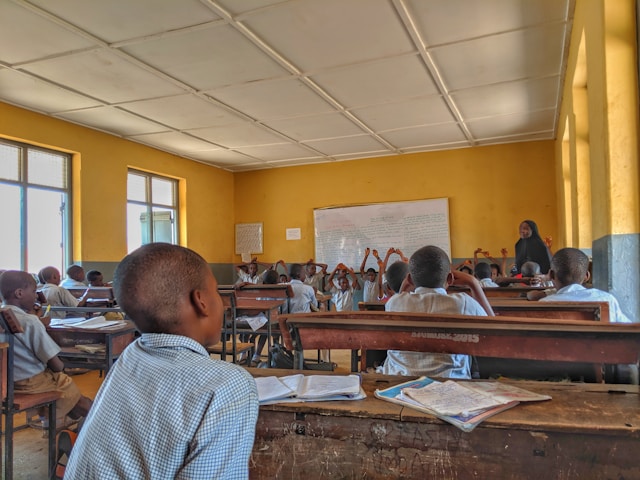
Today’s International Day against Child Labour gives us yet another chance to assess our progress in addressing the ills that it is. It is both convenient and fit for purpose that this year’s commemoration and theme, “Red Card to Child Labour: Fair Play for Children, Decent Work for Adults”, is just a day after the kick-off for the 2026 FIFA World Cup. All the Red Cards shown during this FIFA World Cup should serve as a reminder of what we need to do to root out child labour.
Child labour in the digital age
Much of child labour is associated with the agricultural sector, mining and the manufacturing industries. However, this is no longer the full picture. Today’s child labour is shifting and being shaped by digital systems, platforms, and global tech supply chains. It is alarming and challenging to see how children are being used to create content on social media platforms and how the same platforms are becoming spaces for their exploitation, both sexually and economically, leading to addiction. It is not surprising, therefore, to see the growing number of lawsuits against tech giants in the United States of America, and the mounting pressure on companies like Apple and Google in the UK to act against this ill.[1] While there are laws and frameworks such as the Online Safety Act 2023 (OSA),[2] the General Data Protection Regulation (GDPR),[3] as well as a legal ban on the use of smartphones in schools across different jurisdictions, more remains to be done. With such a background, one needs to ask whether the cybersecurity professional and those involved in governance, risk and compliance are doing enough to keep children safe and protected from all forms of exploitation, including child labour.
ILO and UNICEF’s global estimates on child labour indicate that it has slightly decreased.[4] However, 138 million children involved in child labour is a sad number considering that these are not just statistics. These are children trying to live a well and dignified life among us. Child labour is no longer only physical and invisible. In such situations, one needs to revisit the principle of fair play. It is now embedded in digital ecosystems. It manifests in the creation and monetisation of content involving minors, as seen in the reels we see and share. It is also present, though hidden, in outsourced microtasks that children perform out of the public eye, such as tobacco sorting, making bricks, and childcare. It also hides in supply chain digitisation, which conceals the labour conditions in which children and their parents are involved.[5] Ultimately, technological advancement and the benefits that come with it do not eliminate child labour; they make it less visible and harder to regulate. Child labour regulation needs to include the digital environment and not focus solely on traditional workplaces such as subsistence farming, tourism, and the manufacturing sector.
Where cybersecurity meets child labour
There are already clear connections between child labour, technological advancement and cybersecurity. These include supply chain visibility, data and monitoring systems, and trust and reporting systems.
From companies supplying flowers from Kenya to the Netherlands, designer bags and clothes lining the coasts of India and Pakistan to the USA, and tobacco leaving the auction floors of Malawi to the cigarettes in the pockets of UK citizens, there lie complex global supply chains supported by digital systems. There are various vendors involved in such trade. Similar to the digital supply chain, the cybersecurity industry maps vendors who supply different tools to address market threats, as well as known vulnerabilities and risks.[6] It would not be a stretch, therefore, for the industry to extend its risk assessment to include ethical risk assessment and awareness and make these risks visible in sectors where child labour is more prevalent.
Secondly, there is a wide range of cybersecurity tools that offer trustworthy reporting systems. These systems are secure for whistleblowing, offer encrypted reporting channels, and include protected audit logs and transparency tools. In the fight against child exploitation, such tools and systems can be leveraged to offer protection to human rights defenders and children who are at risk. While reporting on child labour practices involving big tobacco companies in Malawi, artisanal mining companies in Ghana, as well as manufacturing companies in India, the protection mechanism used in cybersecurity can be applied to safeguard those who are on the frontline in the fight for children’s rights.
Data and monitoring systems can be used in both ways. To hide or expose labour exploitation. It would be naïve to think that companies relying on the proceeds of child labour would not use their resources and digital systems to hide their malpractices. With poor data governance and weak monitoring, blind spots emerge, particularly in labour outsourcing and automated services. In this case, when farmers have quotas to supply farm produce to their parent companies, they often involve their children in meeting those quotas. Additionally, to increase productivity and meet contractual obligations, small-scale suppliers often automate parts of their production, resulting in layoffs.[7] These shifts create conditions that increase the risk of child exploitation. If left unchecked, they will undermine efforts to meet the ‘red cards’ goal of eliminating child labour.
Accountability, fair play and way forward
While the child labour issue has been hard to trace and root out in the informal sector, digital advancements have made it harder to detect. However, with advances in digital technology also come security, legal obligations, and risks that companies must address. Thus, in the wake of children’s involvement in digital ecosystems, companies need to ensure that their third-party risks are addressed, that their supply chains meet all compliance obligations, and that their audit trails are robust enough to prevent the exploitation of children. In addition, they need to ensure that decent work for adults is guaranteed so that they are not forced to find alternative digital income that involves the children’s exploitative involvement. Thus, there is a great need to ensure that human rights risks, such as private data leakages, exposure to harmful chemicals and content, including pornography, are formally included in cyber risk assessment to safeguard children in the supply chain.
Ending child labour is no longer just a labour or development issue; it is equally a governance and cybersecurity issue that calls for concerted effort. The theme for this year’s International Day against Child Labour calls for fair play. This means transparency, accountability and responsibility across digital and physical economies. While the teams battle it out in the FIFA World Cup, every red card should remind us of the theme: “Red Card to Child Labour: Fair Play for Children, Decent Work for Adults.” This idea needs to be realised through the growing role of cybersecurity professionals and all those involved in ensuring that supply chains and digital systems are accountable to human rights standards.
[1] Dara Kerr, ‘Meta settles major social media addiction lawsuit with school district’ (The Guardian, 21 May 2026) <https://www.theguardian.com/technology/2026/may/21/meta-social-media-addiction-kentucky-schools> accessed 11 June 2026.
[2] The Online Safety Act 2023 is a landmark UK law that places a duty of care on social media companies, search engines, and other platforms to protect both adults and children online. See Online Safety Act 2023 (c 50) s 2.
[3] See General Data Protection Regulation (EU) 2016/679, Article 8. It sets a digital age of consent at 16 and dictates that online services cannot legally process a child’s data based on the child’s consent.
[4] See International Labour Organization and United Nations Children’s Fund, Child Labour: Global estimates 2024, trends and the road forward (ILO and UNICEF, New York 2025) 15.
[5] Katie McQue, ‘Meta ordered to pay $375m after being found liable in child exploitation case’ The Guardian (26 March 2026) <https://www.theguardian.com/technology/2026/mar/24/meta-new-mexico-jury> accessed 1 June 2026.
[6] Mitre ATT&CK, https://www.mitre.org/focus-areas/cybersecurity/mitre-attack accessed 01 June 2026.
[7] ILO and OECD, Ending child labour, forced labour and human trafficking in global supply chains (ILO, OECD, IOM, UNICEF, 2019) 20.
