Introduction
The Federal Republic of Somalia, located in the Horn of Africa, bears the scars of a past marked by colonial rule, a brief period of independence, and a devastating civil war that began in 1991. The collapse of the central government plunged the country into years of anarchy and clan-based violence, while also enabling the rise of extremist groups such as Al-Shabaab.[1]
In 2012, the establishment of the Federal Government of Somalia raised hopes for stability and the protection of human rights.[2] However, these hopes remain fragile in the face of the legacy of conflict, weak institutions, and ongoing insecurity. Indeed, the armed conflict between the government and Al-Shabaab continues to result in serious violations of international humanitarian law and human rights by all parties involved.[3]
This article aims to provide an in-depth examination of the current human rights situation in the Federal Republic of Somalia, analysing the challenges faced in ensuring human rights protection and the efforts needed to build a more just and equitable society.
The Challenges Facing Human Rights in Somalia
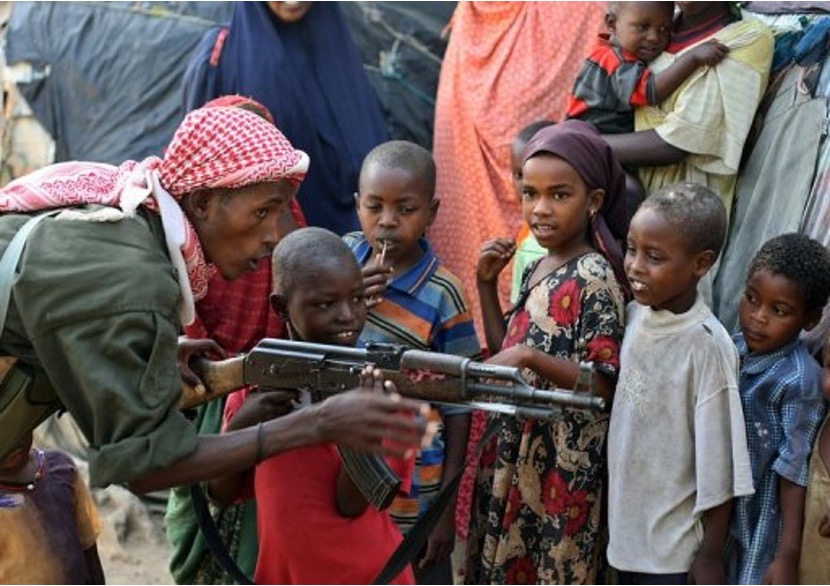
Human rights in the Federal Republic of Somalia are violated, creating opportunities for all kinds of crimes. It is in this context that the country faces serious violations against children that persist in Somalia, taking various forms such as killings, mutilations, recruitment into armed groups, and sexual violence.[4] According to a 2019 UN report, the Federal Republic of Somalia remains the country with the highest number of cases of recruitment and use of children, and there are also reports of children being forcibly recruited and indoctrinated by the terrorist group Al-Shabaab.[5] The lack of access to education is particularly alarming, with newly displaced children suffering from extremely low school attendance rates, perpetuating a cycle of vulnerability.
There is a worrying gap in Somalia’s legal framework on gender-based violence. In this context, in April 2024, the Strategic Advocacy for Human Rights (SAHR) submitted an urgent report to the United Nations, highlighting the alarming state of women’s rights in Somalia and the legal obstacles they face, particularly when it comes to seeking justice for sexual violence from rape, sexual slavery, forced prostitution, forced pregnancy, forced abortion, forced sterilisation, forced marriage and other forms of sexual violence of comparable gravity perpetrated against women, men, girls and boys.[6] In this report, a UN expert noted that the prevalence rate of female genital mutilation in Somalia was as high as 99%, despite its prohibition in the interim constitution and efforts to combat the practice. The figures for early and forced marriages are also very alarming, noting that almost half of Somali girls marry before the age of 18, and 16% even before the age of 15.[7] Despite some legislative efforts, Somalia continues to rely on outdated laws that do not adequately protect women, further reinforcing the culture of impunity.
Additionally, freedom of expression and the press remain severely restricted. This is evidenced by attacks, threats, harassment, intimidation, beatings, arbitrary arrests, and prosecutions targeting journalists, often perpetrated by security forces and Al-Shabaab.[8]
Finally, the death penalty remains in force in the Federal Republic of Somalia[9], violating the right to life, a fundamental right enshrined in Article 3 of the Universal Declaration of Human Rights.[10] The death penalty has been notably to be carried out on people under the age of 18.[11]
The Way Forward
To put an end human rights violations in the Federal Republic of Somalia, several strategic elements must be considered.
First, international human rights regulations, which prioritize the rights of vulnerable populations, including children and women, should be incorporated into national laws. This can be achieved by ensuring compliance with relevant treaties and conventions to which Somalia is a signatory, such as the Convention on the Rights of the Child and the Convention on the Elimination of All Forms of Discrimination Against Women.
Second, the Federal Republic of Somalia should establish and strengthen systems that enable the meaningful participation and protection of vulnerable groups within society. These groups should have the right to engage in key processes, including policymaking, legal reform, and human rights monitoring. Mechanisms should also be put in place to protect journalists and human rights defenders from intimidation and violence.
Third, the Somali government should develop and implement initiatives to raise public awareness of human rights and available legal remedies. The public must be empowered to actively demand accountability from the government and other actors. This includes promoting human rights education in schools and communities.
Fourth, Somalia should ensure compliance with human rights standards by reinforcing monitoring mechanisms and prosecuting human rights violations. Deterring such violations should be a priority, and the interests of vulnerable populations should be safeguarded by holding perpetrators accountable through fair and transparent judicial processes. This includes establishing effective mechanisms to investigate and prosecute human rights violations committed by both state and non-state actors.
Finally, the Somali government must abolish the death penalty, as it contradicts the right to life, and instead promote the rehabilitation of convicted individuals.
Conclusion
The human rights situation in Somalia remains alarming due to ongoing conflicts, severe violations against vulnerable populations, and the continued use of the death penalty. To ensure effective protection of fundamental rights, it is essential to integrate international standards into national legislation, enhance the participation of marginalized groups, and hold perpetrators accountable. Human rights education and the abolition of the death penalty must be prioritised. A concerted national and international effort is crucial to building a Somalia that upholds the rights and freedoms of all.
[1] COMESA, ‘Somalia’ https://www.comesa.int/somalia/?lang=fr 31 January accessed 2025.
[2] See 1.
[3] Amnesty International, ‘Somalia’ https://www.amnesty.org/fr/location/africa/east-africa-the-horn-and-great-lakes/somalia/ accessed 31 January 2025.
[4]Office of the High Commissioner for Human Rights, ‘Review of Somalia by the Human Rights Committee: issues relating to enforced disappearances, violence against women and attacks against journalists are examined’ (UN Geneva, 08 March 2024) https://www.ungeneva.org/fr/news-media/meeting-summary/2024/03/examen-de-la-somalie-au-comite-des-droits-de-lhomme-sont accessed 31 January 2025.
[5] See 4.
[6] SAHR, ‘Somalia’s Call for Legal Reform: Addressing Gender-Based Violence’ (WeAreSAHR, April 2024) https://www.wearesahr.org/blog/somalias-call-for-legal-reform-addressing-gender-based-violence accessed 9 February 2025.
[7] See 4.
[8] See 4.
[9] Federal Republic of Somalia, Criminal Code, 1964, art. 184.
[10] Human Rights Act 1948, 3
[11] Amnesty International, ‘Somalia’ https://www.amnesty.org/fr/location/africa/east-africa-the-horn-and-great-lakes/somalia/ accessed 2 February 2025.
