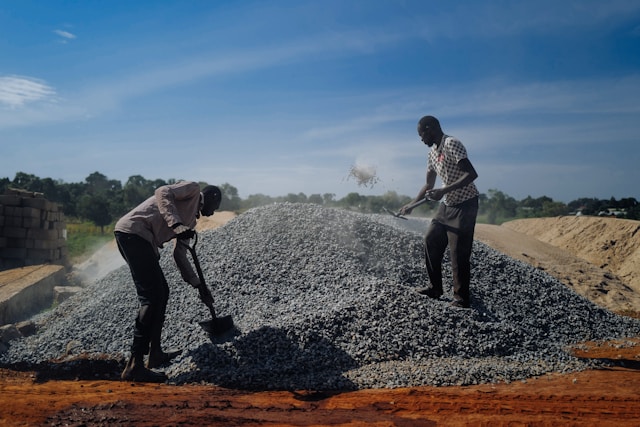
Who makes major decisions about energy? And for whom is energy produced?
Who makes major decisions about natural resources? And for whom are they extracted?
Introduction
These questions are pretty relevant in the context of new tensions on the African continent. Especially considering recent development in Western Africa, where the ECOWAS Alliance faces a big crisis given Burkina Faso’s, Niger’s and Mali’s withdrawal from it – also due to fundamentally different viewpoints in the context of natural resource governance and energy politics.[1] These contemporary developments show that regional communities as well as the African Union must reposition themselves on the global stage. Natural resource governance and energy politics must play a leading role here. Particularly since the African continent is home to at least 30 per cent of the world’s mineral resources, for instance, and can account up to 50 per cent of the countries` wealth.
The goal of this contribution is to show why the well-known concept of Energy Justice must be rethought – no: it wants to show why the concept must be subject to an Afrocentric correction to reflect Afrocentric interests better. Furthermore, this piece is meant as a thought-provoking impulse for scholars dealing with the topic.
My personal starting point: Research on the African Commission on Human and Peoples’ Rights and Energy Justice
As part of my final thesis within my legal studies, I examined the efforts the African Commission on Human and Peoples’ Rights has undertaken to engage with Energy Justice and Corporate Responsibility for Human and Peoples’ Rights.
Of course, one cannot avoid dealing with the concept of Energy Justice here. Central to this are the four normative pillars of the concept:
- Distributive Justice: Fair distribution of energy access, as well as fair distribution of the economic benefits that come with it
- Recognition Justice: Acknowledgment of the interests of marginalized groups
- Procedural Justice: Fair participation of (marginalized) stakeholders in decision-making processes
- Restorative Justice: Compensation for past injustices[2]
In the context of my work, I came to the following conclusion: These sub-pillars provide an interesting foundation but fall too short in the African context. More on this below:
Critique: A concept with a too narrow focus
The African Commission on Human Rights has addressed certain aspects of the concept – mostly in the context of large infrastructure and resource extraction projects. In the 2017 Resolution on the Niamey Declaration[3], for instance, it emphasizes revenue sharing for mining projects and mandates contract negotiations with representatives of communities affected from extractive projects. This can be seen as an outcome of Pillars 1 (Distributive Justice) and Pillar 3 (Procedural Justice).
In general, the focus of actual implementation of the Energy Justice pillars lies in administrative and technocratic processes. Specifically: Environmental Impact Assessments, such as those provided for in Ghana’s Minerals and Mining Act, questions of access to electricity and permitting procedures at municipal level. So, it is mostly about operational aspects.
What is conceptually missing is the systemic engagement with global power relations – or, more accurately put: power inequalities that make such projects like the EACOP Pipeline in Eastern Africa (including their notable negative human rights implications) possible in the first place.
Although the existing Energy Justice concept with its four pillars offers important normative guidance, it reaches analytical limits in the African context. The pillar of Procedural Justice, for instance, emphasizes participation and involvement, but often remains blind to structural power asymmetries that exist long before any formal participation processes, such as the unequal negotiation power between local actors and Multinational corporations (MNCs). Also, Recognition Justice, which aims at acknowledging marginalized groups, falls short when it comes to historically grown inequalities affecting entire regions. The colonial continuities associated with that, for example, in the role of African countries as raw material suppliers for the Global North remain largely underexposed.
MNCs, mostly from the Global North, dominate the energy sector in many African countries. They possess:
- Legal leverage through investment protection treaties which systematically disadvantage Global South states[4]
- Technological monopoly (it is worth looking into the Brussels Effect here, as explained by Anu Bradford)[5]
- Political influence via cooperation with local elites, who often do not represent the actual interests of the people
Both the Natural Resource and the conventional energy sectors are dominated by MNCs, which, through interest-driven lobbying and advocacy, often exercise more power within their sectors than states themselves. It is no coincidence that some international law scholars demand that MNCs be classified as subjects of international law so they can become direct addressees of international obligations.[6] But that is a topic for another day.
The Energy Justice concept does not adequately capture these power asymmetries mentioned. Instead, it remains stuck in ideas of purely operational nature, which are not capable of addressing colonial-era structures at their roots. Energy Justice must do more in the African context.
What is necessary? Different levels for further developing the concept
To make Energy Justice effective in the African context, the concept needs several levels of further development, and a more explicit focus on its underlying goal. I will first outline this foundational goal that should accompany any initiative in this context and then turn to the one concrete development level (There are certainly more levels – I am focusing on geopolitics and geoeconomics here)
The foundational goal of the Energy Justice concept must be to counter existing power inequalities and neocolonial continuities effectively. The concept must be embedded in a broader decolonial (which for me means: guided by Afrocentric interests) context. To emphasize once more: The focus on operational aspects is not enough.
Geoeconomic and geopolitical development of the concept
African states need to strengthen their energy-policy negotiation position globally, for example in climate negotiations, multilateral development banks or South-South initiatives. The previous dependency on a few partners in the Global North has proven structurally problematic. Diversifying alliances, for instance through stronger cooperation with countries in Latin America or Southeast Asia can open new scope for action, especially where similar experiences with resource exploitation and asymmetric power relations exist.
To strengthen their negotiation position, it will also be necessary that AU states with similar energy and natural resource concerns align on shared interests. This is not about idealistic goals, but interests that can be directly translated into everyday economic practice.
To achieve this, it is necessary to consider designing an African integration model as a sub-pillar of the Energy Justice concept. Such a model should aim to ensure that countries in the region develop in a similar pace in different areas of energy and natural resources governance. This will promote the building of a continental economic identity, prevent intracontinental fragmentation, and foster truly shared interests that are directly translatable into practice.
Energy justice as a concept must also find answers to these global interdependencies. A focus on operational aspects only will not take AU member states where they want to go in the future. Especially considering Agenda 2063.[7]
Africanizing Energy Justice – An invitation to debate
With this contribution, I want to spark a discussion that africanizes the concept of Energy Justice and adapts it to the socio-economic, cultural and historical realities of the continent. Only if the concept considers the historical dimensions of inequality and the transnational entanglement of power structures can it live up to its ambition.
Today I gave a brief introduction to my thoughts and focused on geopolitics and geoeconomics. Indeed, there are more levels on which the concept must evolve. Further academic exchange on this subject is indispensable.
[1] ECOWAS loses membership of Burkina Faso, Mali and Niger, Deutsche Welle (29 January 2025).
[2] Godswill A Agbaitoro (2024) Implementing energy justice through corporate social responsibility of multinational corporations in energy and extractive industries: old body in new robes, Journal of Energy & Natural Resources Law.
[3] Resolution on the Niamey Declaration on Ensuring the Upholding of the African Charter in the Extractive Industries Sector – ACHPR/Res.367(LX)2017.
[4] Interesting note here: Anna Hankings-Evans, China-Africa BITs in View of Global Shifts of Power. About Standards of Power and Justice in Investment Law Relations (first published in 2024, Mohr Siebeck).
[5] The following work is worth looking at: Anu Bredford, The Brussels Effect: How the European Union Rules the World (first published in 2019, Oxford University Press).
[6] Hassan M Ahmad, ‘The Jurisdictional Vacuum: Transnational Corporate Human Rights Claims in Common Law Home States’ (2022) 70 Am J Comp L 227.
[7] African Union, Agenda 2063: The Africa We Want (Final edition, 2015) <https://au.int/sites/default/files/documents/36204-doc-agenda2063_popular_version_en.pdf> accessed 7 August 2025.

One reply on “Energy Justice: Time for an Afrocentric Perspective”
[…] Justice: Time for an Afrocentric Perspective’ (African Legal Studies Blog, 8 August 2025) < https://africanlegalstudies.blog/2025/08/08/energy-justice-time-for-an-afrocentric-perspective/> accessed 02 October […]