At the outset of my doctoral journey, I knew with certainty that I wanted to investigate and address social injustices embedded in mineral resource governance in the context of Burundi. What I could not have anticipated was how this journey would reshape not only my understanding of law but also my connection to the philosophical foundations of African societies. I wanted my research to provide something genuinely valuable to Burundi, that would speak to our reality, our struggles, and our aspirations for justice.
The initial phase of my research felt familiar. Western legal philosophies had been my companions throughout my undergraduate and postgraduate studies. I could trace their influence through the normative, institutional, and procedural frameworks that govern mining operations in Burundi today. Rooted in colonial legal traditions and contemporary international standards, these frameworks appeared comprehensive on paper. However, something felt incomplete.
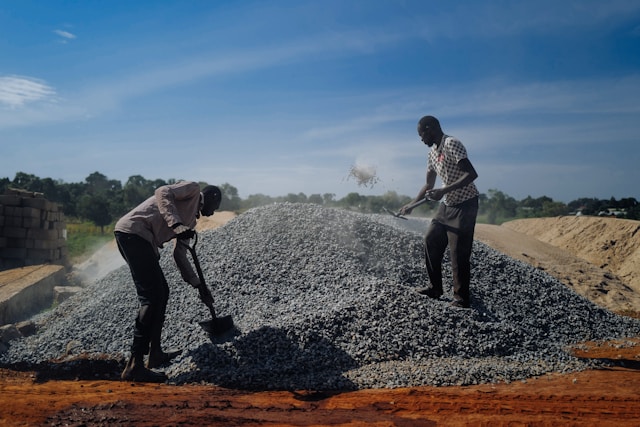
It was during my research trips to the mining provinces of Burundi that the disconnect became impossible to ignore. There, amongst the communities living where mining operations unfold, I witnessed a stark reality: what the law provides and what the law delivers exist in entirely different worlds. The carefully crafted legal texts, with their Western philosophical underpinnings, seemed to dissolve into irrelevance when confronted with the lived experiences of mining communities. The law,as framed, was not delivering social justice.
Then came the moment that would define my entire doctoral research. I met an old woman. She had lived on land where mining operations were taking place. What she asked pierced through years of legal education and theoretical foundations: “Whose law protects us?”
In that simple yet profound question lay the entire problem I needed to solve. The current frameworks, I realised, were ingrained in philosophical roots that fundamentally disconnect mining activities from mining communities. In so doing, they frame land as property, resources as commodities, and communities as stakeholders to be managed rather than as rights-bearers with inherent dignity and connection to their ancestral lands. Far from being merely administrative or procedural, this disconnect was philosophical.
Thus began my search for a more appropriate philosophical foundation. One that would reflect the realities of African societies and particularly Burundian society whilst providing a defensible framework for legal reform. I needed a philosophy that could appreciate our interconnectedness, our relationship with land, and our collective responsibility to one another. Ubuntu emerged as that unique philosophy.
Ubuntu is not simply a moral philosophy. It is a lived reality that has bound our societies across generations. It recognises that we exist in relation to one another, that our humanity is inextricably linked to the humanity of others. In the context of mineral resource governance, Ubuntu offers a radical reimagining of how we understand rights, responsibilities, and justice. It challenges the individualistic frameworks imported from Western legal traditions and replaces them with a relational understanding of existence.
The most challenging aspect of my doctoral work became clear: how could I transform Ubuntu from a moral philosophy into a legal principle? This was not merely an academic exercise. It required thinking deeply about constitutional architecture, legal pluralism, and the mechanisms through which moral values become enforceable legal standards. I spent countless nights wrestling with this question, guided by the invaluable insights of my supervisor.
It became clear that the answer lies in recognising that African legal systems are pluralist. It is paramount to recall that before colonialism, our societies operated under customary laws rooted in Ubuntu principles. These laws developed from community practices, traditions, and social norms over time. They understood identity and solidarity not as abstract concepts but as the very foundation of social structure. The challenge was to reclaim this pluralism within our contemporary constitutional frameworks.
I proposed codifying the two core moral values of Ubuntu, being identity and solidarity within our constitutional model as living customary law. This approach acknowledges that customary law is not static or historical but continues to evolve and adapt to contemporary challenges. By embedding Ubuntu principles at the constitutional level, we create a foundation from which specific legal principles can flow into sectoral legislation, including mining law.
This framework transforms how we understand mineral resources and the communities affected by their extraction. These resources, inherited from our ancestors cease to be merely commodities to be exploited. They become part of the relational web that connects communities to their land and to one another. Mining operations must be evaluated not only for their economic benefits but for their impact on these fundamental relationships.
The journey to completion was long. There were moments of doubt, particularly when attempting to bridge philosophical concepts with legal technicalities. Yet each challenge reinforced the importance of this work. Every time I returned to the question of Collette, I found renewed purpose.
As I reflect on this completed journey, I am filled with a profound sense of duty. I am eager to find Collette and tell her that Ubuntu as a relational framework can protect us. It can address the social injustices that have plagued mineral resource governance in our country. More importantly, it provides a foundation that is authentically African whilst being legally robust and internationally credible.
This doctoral journey has taught me that legal reform is not simply about drafting better statutes or creating more efficient institutions. It is about ensuring that the law speaks to the people it governs, that it reflects their values and protects their dignity. For Burundi, and perhaps for many African nations grappling with resource governance challenges, Ubuntu offers a path forward that honours our past whilst building a more just future.
The question that began my journey ‘Whose law protects us?’ now has an answer. It must be our law, rooted in our philosophy, responsive to our needs, and committed to our collective and sustainable development. As both a moral philosophy and a legal principle, Ubuntu provides that foundation. As I reflect on my PhD journey, this is my contribution to Burundi. I hope it marks the beginning of a broader transformation in how we understand law, justice, and community in the context of mineral resource governance.
This contribution is a reflection by Ange Dorine Irakoze a on her journey as a Ph.D. candidate at the Chair of African Legal Studies, which she successfully completed in 2025 as one of three graduates. Her dissertation can be found here.
